
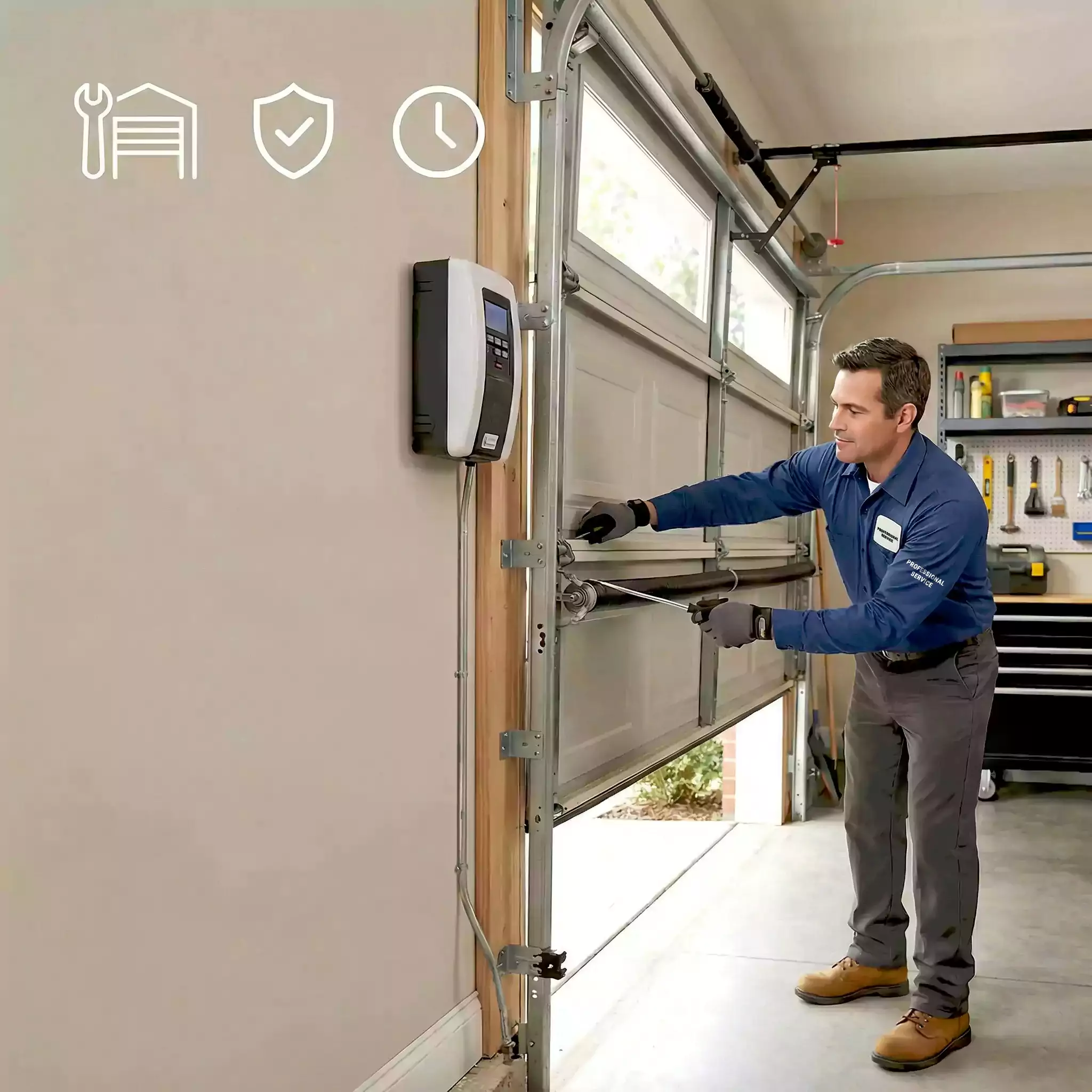
Understanding Your Garage Door System
A garage door is the largest moving part of your home, operating thousands of cycles per year under significant mechanical tension. Understanding its components is the first step to knowing when something's wrong — and how serious it is.
The door panels are the most visible component — typically steel, aluminum, wood, or composite. They're connected by hinges and ride along horizontal and vertical tracks mounted to your garage walls and ceiling. The panels themselves rarely fail, but the hardware connecting them does: worn hinges, bent tracks, and broken rollers are common maintenance items.
The spring system is the most critical — and most dangerous — component. Springs counterbalance the door's weight, making it possible for the motor or a person to lift it. There are two types: torsion springs (mounted horizontally above the door on a metal shaft) and extension springs (mounted along the horizontal tracks on each side). A broken spring makes the door immovable and must be replaced by a professional — never attempt this yourself. Springs are under extreme tension and can cause serious injury or death if mishandled.
Garage door springs are under hundreds of pounds of tension. A spring that snaps during DIY repair can cause severe lacerations, broken bones, or death. This is the one garage door repair that should always be left to a trained professional, no exceptions.
The opener is the motorized unit mounted to the ceiling that automates door operation. It connects to the door via a drive mechanism — chain drive (durable, louder), belt drive (quiet, slightly more expensive), screw drive (minimal maintenance), or direct drive (quietest, fewer moving parts). The opener also houses the safety systems: photo-eye sensors near the floor that reverse the door if something is in the way, and the auto-reverse force setting that stops the door if it meets resistance.
Types of Garage Door Services
Garage door work ranges from quick hardware fixes to full system replacements. Knowing the service category helps you get the right technician and evaluate whether a quote is reasonable.
Replacing broken or worn torsion or extension springs. The most common repair call. Always replace both springs at once — if one broke, the other is near the end of its life too.
Diagnosing and fixing opener motor issues, circuit board failures, drive mechanism problems, and remote/keypad programming. Replacement if repair isn't cost-effective.
Straightening bent tracks, re-aligning misaligned sections, and replacing damaged track hardware. A door off its track should not be forced — it risks panel and cable damage.
Replacing frayed or snapped lift cables that connect the springs to the bottom brackets. Like springs, cables are under tension and should be replaced professionally.
Full door replacement including panels, tracks, springs, and hardware. Options range from basic steel to insulated, custom wood, or carriage-house style doors.
Aligning, cleaning, or replacing photo-eye sensors. Federal law requires auto-reverse sensors on all openers — a door that doesn't reverse on obstruction is a safety violation.
Lubricating rollers, hinges, and springs; replacing worn nylon rollers; tightening loose hardware; and installing anti-vibration pads on the opener mounting bracket.
Replacing bottom seals, side and top weatherstripping, and adding insulation panels. Critical for attached garages — an uninsulated door is a major thermal weak point.
What Garage Door Services Actually Cost
National average ranges below. Actual prices vary by region, door size, and job complexity. Use these as a baseline for evaluating quotes — not a final budget number.
| Service | Typical Range | Key Cost Drivers |
|---|---|---|
| Service call / diagnosis | $50–$100 | Often applied toward repair if booked same visit |
| Torsion spring replacement (both) | $200–$350 | Spring size/cycle rating, single vs double door |
| Extension spring replacement (pair) | $150–$280 | Spring weight rating, safety cable inclusion |
| Cable replacement (pair) | $100–$200 | Cable gauge, door weight |
| Roller replacement (set) | $100–$220 | Nylon vs steel, number of rollers |
| Track repair / realignment | $125–$300 | Severity of bend, section replacement vs repair |
| Opener repair | $100–$300 | Circuit board vs motor vs drive mechanism |
| Opener replacement (installed) | $350–$750 | HP rating, drive type, smart features |
| New single garage door (installed) | $700–$1,800 | Material, insulation R-value, style |
| New double garage door (installed) | $1,200–$3,500 | Material, insulation, carriage-house vs standard |
| Weatherstripping replacement | $80–$200 | Linear footage, seal type |
| Full tune-up / annual maintenance | $75–$150 | Number of doors, condition of hardware |
If your door is stuck open — especially in cold weather or for security reasons — most companies offer emergency service with a $75–$150 surcharge. If the door is stuck closed and your car isn't inside, it's usually worth waiting for a regular appointment to avoid the premium.
When to Call a Tech — and When to DIY
Garage doors have some genuinely safe DIY tasks — and some that are seriously dangerous. The dividing line is almost always whether springs or cables are involved.
DIY-appropriate: lubricating rollers and hinges with garage door spray lubricant (not WD-40), replacing remote batteries, reprogramming remotes and keypads, cleaning and realigning photo-eye sensors, replacing weatherstripping at the bottom seal, tightening loose bolts on tracks and brackets.
Broken or visibly damaged springs · Frayed or snapped lift cables · Door that came off its tracks · Door that won't reverse when it hits an object (safety system failure) · Opener that runs but door doesn't move · Any loud bang from the garage (often a spring breaking) · Door that falls or slams shut rather than lowering controlled
Always hire a professional for: any spring work (torsion or extension), cable replacement, track replacement on double doors, new door installation, opener electrical wiring, and any repair where the door is partially off track and under tension.
Permits: What Requires One and Why It Matters
Garage door permits are less universally required than plumbing or HVAC, but they do apply in specific situations — particularly new installations and opener electrical work.
Work that typically requires a permit: installing a new garage door opening where none existed before, adding a new 120V electrical circuit for an opener, replacing a door in a fire-rated wall between the garage and living space (must meet fire-resistance standards), and new construction rough-in.
Work that typically does not require a permit: replacing an existing door with a same-size door, spring and cable replacement, opener replacement on an existing circuit, and all maintenance and repair work.
If your garage is attached to your home, the door between the garage and the house must meet fire-resistance codes — but your garage door itself (facing the driveway) does not. However, if you replace a garage door in an HOA community, many associations have style and material approval requirements separate from building permits.
How to Hire the Right Garage Door Company
Garage door work is less regulated than plumbing or HVAC in most states, which means the barrier to entry is lower — and so is the accountability. Verification matters more, not less.
Some states require a contractor's license for garage door work; others don't. Check your state's contractor licensing board. Even where not required, membership in the International Door Association (IDA) signals a company that takes professionalism seriously.
Require proof of general liability insurance and workers' compensation before any tech enters your property. Garage door work involves heavy components under tension — the injury risk is real, and an uninsured worker injured on your property can create personal liability.
Any quote should specify spring cycle rating (10,000 vs 25,000 cycle springs are very different products at very different prices), brand and model of opener if replacing, and whether hardware like cables and rollers are included. "Spring replacement — $150" without specs is not a complete quote.
Torsion springs are rated by cycle count — a cycle is one open/close. Standard springs are 10,000 cycles (~7–9 years for average use). High-cycle springs run 25,000–100,000 cycles and cost more upfront but last far longer. Always ask what cycle rating the replacement spring carries.
Look specifically for reviews mentioning whether the tech pointed out additional issues without upselling aggressively, arrived on time, and left the area clean. Garage door scams often involve "free inspections" that result in inflated repair lists — pattern reviews catch this.
Red Flags to Watch For
The garage door industry has a documented problem with predatory pricing and bait-and-switch tactics. These patterns are well-established — know them before you call.
- Advertises extremely low spring replacement prices ($29, $49) — these are loss-leaders with massive upsells at the door
- Replaces working components without showing you the failed part or explaining why replacement is needed
- Cannot specify the cycle rating of replacement springs when asked directly
- Pressures you to replace the entire system when only one component has failed
- Refuses to provide a written itemized estimate before starting work
- Cannot provide proof of insurance when requested
- Has no physical business address — operates only via online ads or phone, no verifiable location
- Final invoice significantly exceeds the verbal or written estimate without prior notice
A common tactic: a company advertises free inspection and low-cost spring replacement. The tech arrives, declares multiple components "dangerous" or "about to fail," and presents a $800–$1,500 repair list. Legitimate companies do point out real issues — but they show you the problem, explain it in plain language, and don't pressure same-day decisions on non-emergency items.